
Pacific Avenue Road Repairs: Center Line Striping
Update 06/18/2026: Added comment about car damaged on Pacific. Did some minor editing to improve readability.
The City of Paso Robles recently did repairs on Pacific Avenue from Olive Street, west to Merry Hill Road. This included some digging out of sections for more major repair, and then a slurry coat. Overall, it looks like they did a good job. It was overdue.
What I question is the striping they then applied to the road. It includes double solid yellow lines with a row of reflectors on each side. I first noticed it when the initial guide markers were applied—as a preparation for the final painting and reflector installation.
In this post, I suggest that the center line striping used on Pacific Avenue is unnecessary and could very well make Pacific Avenue more dangerous than if no striping is used. I’ve communicated my concerns to the city, and had some limited interaction—as I describe in this post. After documenting my findings here, I’ll send them to the city in a subsequent email communication. I will update this post if they respond and if they send me any information that changes my conclusions.
Traffic standards (used by the city) indicate that the amount of traffic on Pacific Avenue is not high enough to require center line striping. In addition, center line striping has shown to increase speeds where they are used and can lead to territorial or aggressive behavior because drivers perceive a sense of ownership when their lane is defined by a center line. These results can make traffic especially dangerous to pedestrians on Pacific Avenue—of which there are many on any given day—because of the higher driving speeds and drivers potentially being less likely to give up their lane (move over) to a pedestrian.
Furthermore, if the center line striping is not necessary on Pacific Avenue and can result in these negative effects, it doesn’t make sense that a city—especially a city with inadequate budget for its much needed road repairs and maintenance—should be installing such center lines. These painted lines will not last as long as the road surface, and based on past maintenance experiences, it is unlikely that they will be repainted in a timely manner by the city. And then there’s the added cost of maintaining these lines—when the city is already having trouble maintaining roads and other infrastructure. It’s my recommendation that the city adopt a standard similar to other cities—and not use center lines on our residential streets unless dictated by a use-specific engineering judgement.
The center line striping on Pacific Avenue struck me right away as being ‘too much’. This is not a highway; it’s a residential street. I, and many other community members, walk on this street. Some like myself are walking their dog. As there are no sidewalks along most of Pacific Avenue, pedestrians often depend on drivers to move over towards the center of the road (when safe) to give us more room. Walking on a street with no sidewalk just a couple of feet from a vehicle passing by at 25+mph can be a frightening experience. It’s even more dangerous when walking a dog as dogs are often afraid of cars and especially trucks and can be hard to handle when a vehicle passes so close. Sadly, some people just refuse to move over, and I feared that this new striping will discourage even more drivers from moving over.
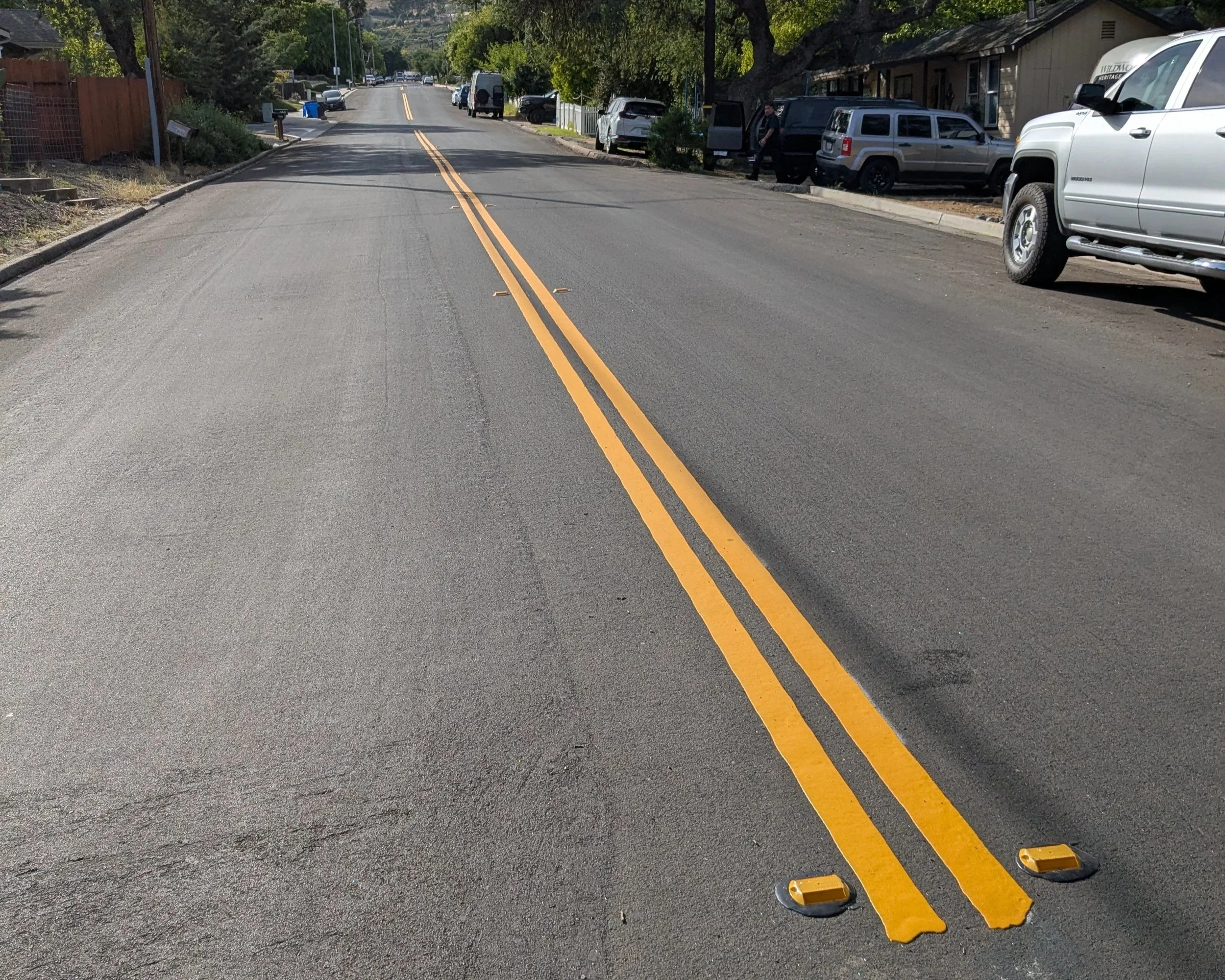
Looking west on Pacific Avenue near Peachy Court.
Sending My Concerns in an Email to the City
The day I first noticed this, I sent an email to the City of Paso Robles Public Works Department. The following is the text of that email.
Hello,
Today, I'm noticing the new striping being put down on Pacific Avenue. I'm not sure why the need for a double yellow line and double reflectors along that route. The existing dashed-yellow on much of Pacific seemed to work OK. It's not a highway; it's a residential street.
I wouldn't encourage passing on this street--but at a 25mph speed limit, it's not clear it will happen much unless the passing driver is speeding. I don't recall ever seeing anyone cross the line to pass, unless a vehicle was stopped in the street, or because a vehicle was parked and didn't leave enough room to get by without crossing the center line. -- Regardless, I feel a single yellow line would have sufficed to make passing illegal.
My concern is that people will be even less likely to move over the line to give pedestrians room now that it's a double yellow line with reflectors.
My concerns stem from my daily experience walking my dog on Pacific Avenue. The majority of Pacific does not have sidewalks and often my safety can depend on someone being willing to cross the center line to give me more room when there's no traffic in the opposite direction. But for whatever reason, sadly some people simply refuse to cross the line to give me more room. Having a car pass at 25+mph at as little as 2 feet away from me--with a skittish dog--can be frightening. (No, I am not asking for walking or bike lanes to be painted, and I hope that doesn't happen. There just isn't room.)
But I wonder how much thought you put into this decision to upgrade to the double yellow line. Sure--it's obviously going to be more safe for drivers, but maybe it's overkill and will end up being more risky for pedestrians? In my 10 years living here, I'm not aware of a single vehicle accident on this street caused by someone crossing the center lines.
So time will tell how this change affects the many pedestrians and dog-walkers walking in the street on Pacific Avenue on a daily basis. I hope I'm wrong about how this might influence drivers.
Jeff Carr--Paso Robles, CA
I received a reply from the department’s administrative assistant acknowledging it was received and would be forwarded. But beyond that, I didn’t hear any response to my concerns—and the striping and reflectors were installed within days.
Standards and Practices for the Use of Striping on Roads
After sending my concerns in an email to the city, I looked closer at the use and effects of road striping, and the documented guidelines for its use in this situation—and was able to find some interesting and enlightening information. My findings can be divided into two areas:
When striping is Required and When It Isn’t Required
Pros and Cons of Residential Road Striping
In numerous publications, I found that centerline markings are not always required. According to the California Manual on Uniform Traffic Control Devices (MUTCD) —
Section 3B.02 Warrants for Yellow Center Lines
Standard:
Center line markings shall be placed on all paved undivided two-way urban arterials and collectors that have a traveled way of 20 feet or more in width and an ADT of 6,000 vehicles per day or greater. Center line markings shall also be placed on all paved undivided two-way streets or highways that have three or more lanes for moving motor vehicle traffic.
Guidance:
Center line markings should be placed on paved urban arterials and collectors that have a traveled way of 20 feet or more in width and an ADT of 4,000 vehicles per day or greater. Center line markings should also be placed on all rural arterials and collectors that have a traveled way of 18 feet or more in width and an ADT of 3,000 vehicles per day or greater. Center line markings should also be placed on other traveled ways where an engineering study indicates such a need.
Engineering judgment should be used in determining whether to place center line markings on traveled ways that are less than 16 feet wide because of the potential for traffic encroaching on the pavement edges, traffic being affected by parked vehicles, and traffic encroaching into the opposing traffic lane.
Option:
Center line markings may be placed on other paved two-way traveled ways that are 16 feet or more in width.
If a traffic count is not available, the ADTs described in this Section may be estimates that are based on engineering judgment
Per Section 3B.02 of this standard and guidelines for 2-way traffic as on Pacific Avenue:
Center lines striping “shall” be used on urban roads with a traveled way of 20 feet or more in width and with and Average Daily Traffic (ADT) of 6000 vehicles per day or greater.
Center lines striping “should” be used on urban roads with a traveled way of 20 feet or more in width and with and Average Daily Traffic (ADT) of 4000 vehicles per day or greater.
I believe it’s safe to say that Pacific Avenue does not see anything close to an ADT of 6000 or 4000 vehicles per day or greater. So why is the city installing center lines here? What “engineering judgement” is dictating this need? I asked that question of the City of Paso Robles; more on that later in this post.
Other articles I found discuss the pros and cons of using center line striping on residential streets. Here is a sample:
For a Walkable City, Remove Centerlines on Local Streets by Jeff Speck — Here the author says center line stripes don’t belong on residential streets without a site-specific justification. It is believed by engineers that center lines “can make drivers feel more confident, causing them to speed as a result”. In a study, “The city repaved three two-lane regional roads without center lines, and compared driver speeds before and after. The results did not disappoint: when adjusted for the not insignificant impact of fresh pavement—which notably tends to encourage speeding—drivers on the reconfigured streets slowed down about 7 mph on average.”
A 7 mph increase in speed can be significant from the point of view of a pedestrian.
Ask R. Moses: Does Center Line Striping Make Streets Safer? by R. Moses — This article reinforces the evidence that center lines will tend to increase a driver’s speed. It mentions the idea that center lines can give drivers the perception that the ‘assigned’ lane is now theirs and will not be infringed by others. This may lead to increased speeds or drivers less willing to share their lane with others—like pedestrians.
Centerline Striping of Residential Streets by the City of Escondido Neighborhood Services Division — Here,
“The City of Escondido does not paint center lines in residential areas for the following reasons:
Traffic signing and striping plans are required for all streets that are 64-feet wide, (curb-to-curb) or wider. Most residential streets are 40-feet wide, not the required 64 foot wide, curb-to-curb.
The mandatory requirement for a painted centerline is at least 4,000 vehicles trips per day. Most residential streets do not meet this requirement.
Citizens view a double yellow line as a "major roadway” and studies have shown that with lane separation striping, vehicle speeds actually increase.”
Notice too, from this reference, that a benefit with no center lines is that it “Reduces the potential for “hit-parked-vehicle” type collisions, . . .”. Early in the week of 06/15/2026, there was a car parked on the eastbound side of Pacific Avenue just east of Maple Street that had a driver’s side side view mirror torn off and strewn along the street. It’s very possible that the new center lines here contributed to this event.
They then go on to state several neighborhood benefits that can be achieved by not having center lines. It’s my recommendation that the City of Paso Robles adopt such a policy for residential streets.
Public Record Request to the City of Paso Robles
After studying the MUTCD and other articles regarding the use of center lines on residential streets that defined the need only if the street’s Average Daily Traffic (ADT) exceeded 4000 — unless ‘engineering judgement’ defends its use. I wanted to know if the city had used any specific ‘engineering judgement’ when they chose to put center lines on Pacific Avenue.
So—I sent the city a Public Record Request asking for, “All data, analysis, calculations, engineering judgments, and plans justifying and related to new street striping on Pacific Ave from Olive St to Merry Hill Rd.”
The city responded with 5 documents. The documents however all define how the center lines should be applied and constructed once it is decided they should be used. They make no reference to ADT on Pacific Avenue or an ‘engineering judgement’ that would provide an understanding of why center lines were used in the first place. There is no reference to MUTCD Section 3B.02.
The 5 documents can be accessed below:
